Your killer SaaS app

Is your SaaS value proposition convincing enough without automatic data entry? 
Imagine you’ve just created the next ‘killer’ Software as a Service (SaaS) app and you are absolutely convinced your new software service is going to revolutionize a particular industry or solve a significant pain point for organizations all over the world.  You create some compelling sales and marketing materials with a heavy emphasis on Return on Investment.  After all, you have conviction that your service is going to help businesses decrease operational costs, improve worker productivity and provide much better access to information which all translates to achieving tangible payback on your customer’s technology investment.
So you’ve done your research, you’ve developed the software application; you created awesome marketing materials, assembled a sales team and created a terrific support structure but for some reason your totally revolutionary SaaS application just isn’t selling as well as you had hoped.  Do you think that you might be overlooking a feature or function that is so fundamental to providing tangible Return on Investment that customers simply cannot say “No” to immediately deploying your innovative solution?

whats missing_data capture
Time is money
I might really be overstating the obvious but employers pay employees to work, not do data entry.  Whether your core expertise is in accounting, customer service or mechanical, your employer pays you to spend a majority of your time focusing on your respective skills.  However, organizations often overlook the total amount of time that is consumed with such tedious activities such as manually entering data from a bank statement into an accounting system.  Or how many total hours field service technicians are spending collecting and entering work order data into an ERP system.  These are real, tangible costs that the organization is paying.  This directly relates to unrealized business productivity and effects the financial bottom-line significantly.  Time is money and time utilized manually entering data into systems is, quite frankly, a waste.
Use cases for Information Capture
Let’s take a look at a few use case scenarios and focus on Mobile Information Capture, specifically, since there is a lot of interest in this area and there is an abundance of data to support that this is one of the greatest opportunities to achieve quick return on investment.
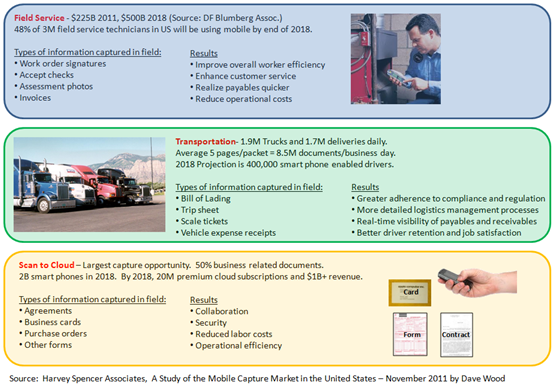
First, consider the industry of Field Service technicians.  According to a November 2011 study by Dave Wood of Harvey Spencer Associates (HSA) entitled “A Study of the Mobile Capture Marketing in the United States”, he cites DF Blumberg Associates as sizing the Field Service market at $225 billion in 2011 and growing to $500 billion by 2018 with nearly half of the 3 million workers using mobile productivity solutions by then.  Since a good majority of these mobile devices will most likely be equipped with a camera this translates directly into a great opportunity to provide these workers with the ability to nearly effortlessly snap pictures of objects such as work order signatures, checks for payment, assessment photos or even invoices and then automatically have the data extracted from these images to populate database fields in a Field Service SaaS application.  Just to name a few of the Field Service benefits for Mobile Capture could be enhanced customer service, the ability to realize the payments quicker and, of course, improve overall worker efficiency.
hsa
In a second use case scenario, also taking data from the same Mobile Capture Market survey, consider the Transportation industry.  For the survey, they focused on Long Haul Trucking.  They found that this particular market featured 1.9 million trucks and 1.7 million deliveries daily.  The research showed that each delivery generated a packet of documents that must be captured for invoicing, with an average of 5 pages per packet.  This translated into a total capture volume of this market of 8.5 million documents PER business day.  The types of items that needed to be captured will slightly vary depending on the particular trucking organization, yet generally documents such as Bills of Lading, Trip Sheets, Scale Tickets and Vehicle Expense Receipts were common amongst most organizations.  After some calculation of the projected number of drivers that will have access to dedicated scanners or multifunction devices, the survey predicted that approximately 400,000 drivers will have only smart phones as their primary capture device.  This presents a terrific opportunity to capture all these documents DURING the trip instead of waiting until the trip is complete which could be days, or even weeks later.
The last use case scenario shared by the HSA survey was general Capture to Cloud.  This was predicted to be, by-far, the largest growth opportunity for Mobile Capture and anyone would be hard pressed to argue this prediction.  With the prediction of 2 billion smart phones by 2018 and cloud storage vendors competing like crazy for market share, it only stands to reason that these factors are going to contribute to huge growth for Capture to Cloud applications using mobile devices.
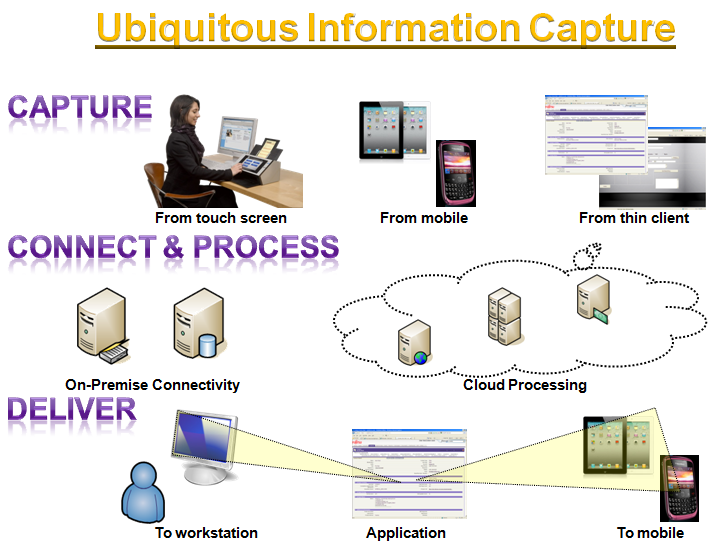
Bringing easy to use, yet highly-effective Ubiquitous Information Capture into the mix
Now that you have your killer SaaS app ready for prime-time.  Your story is polished and you are earning business because your SaaS application is addressing customer pain points such as decreasing operational costs, improving worker productivity and providing better access to information.   You can prove, without a doubt, a tangible Return on Investment with reduced labor costs associated with manual data entry and you recognize the unbelievable potential in the Mobile Capture market, so the question begs, ‘what do you do to make your SaaS application even more appealing to potential customers?’

current solution offering
‘Add Data Capture to you SaaS’ is the answer.  It’s really that simple.  The technology has evolved over the past couple years so that the technology offers extremely advanced features and functions that are completely transparent to the users themselves.  This helps achieve a pleasant user experience which helps drive adoption of the solution among users.  Additionally, the behind-the-scenes technology is performing tasks traditionally done by humans so the processing is highly effective from an automation standpoint.  The user simply snaps a picture and this technology can automatic recognize the type of document and will intelligently extract all the information from the image.

enhanced solution offering
With this new Data Capture capability not only will your SaaS application provide a much more elegant user experience but you can absolutely guarantee cost savings to your customers with the quantifiable amount of time that is recouped by not having users do manual data entry.  The benefits of your SaaS can be incrementally increased with this new Data Capture capability.  Overall you can offer a truly appealing ROI story before you even being to discuss all the wonderful capabilities of your particular application.  The additional features are just like icing on the cake to solidify the sale.

Total Hours x Dollars per Hour = Tangible Cost Savings

This helps achieve a few things in your favor as the preferred software vendor of choice:
* Encourages your customers to make a quicker decision on purchase and implementation of your solution because every day they choose not to make a decision they are squandering money and resources
* Helps differentiate your application from competitors with valuable business functionality that makes the user experience much more enjoyable and helps drive higher adoption rates
* The likelihood of selling more subscriptions to your customers is higher because they can justify adding more licenses due to the fact that they have proven ROI
uic_large
So, are you ready to take your killer SaaS app to the next level with Ubiquitous Information Capture?

 

Frankie-the-frustrated worker dealing with lack of direct Line of Business integration and Manual Data Entry

1For this particular blog post I would like to use a light-hearted approach to a major problem.  The problem is lost productivity and user frustration around populating data into Line of Business applications via Manual Data Entry versus Automation.

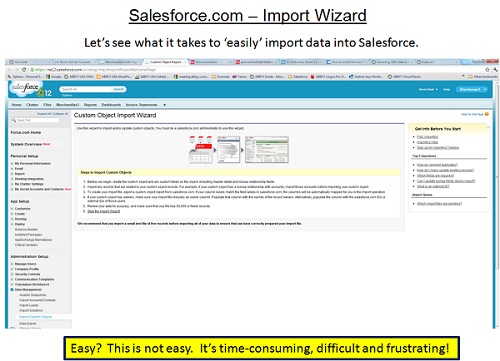
To illustrate my point let’s take one of the most popular Software as a Service (SaaS) applications ever, Salesforce.com.  And while the application is absolutely simple to use and easy to manage, what lacks is the ability to take information from paper and/or an image and put it directly into Salesforce.com database fields.


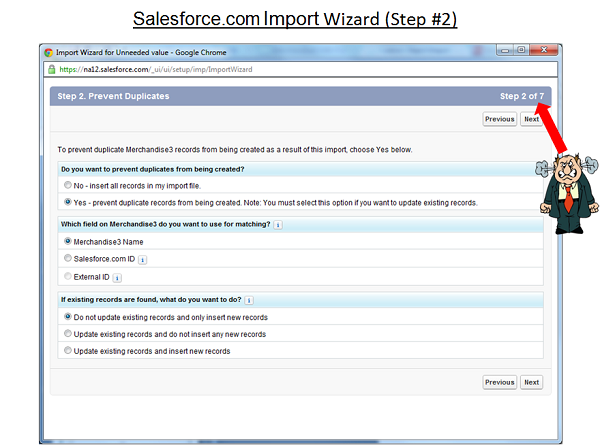
1.  Let’s take a moment to go through the steps to import data into Salesforce.com and follow the steps Frankie-the-frustrated worker must take to get this task done.
2
2.  Commentary of Frankie-the-frustrated worker:


“Frustrating!  Step 1 of 7????”


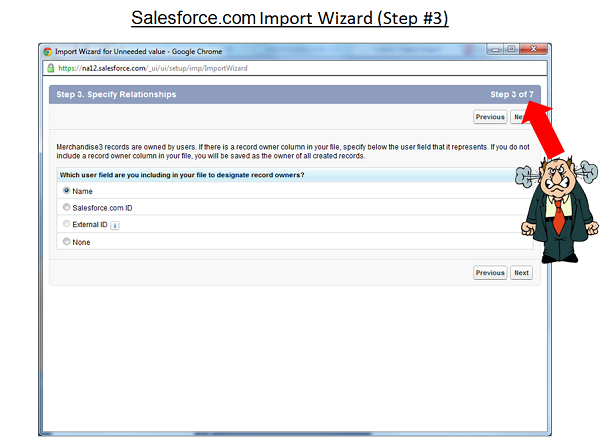
3
3.  Commentary of Frankie-the-frustrated worker:


“MORE FRUSTRATING!!!  WASTING TIME!!!”


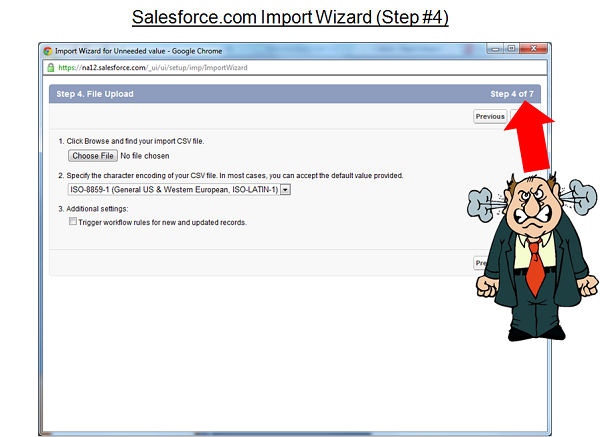
4
4.  Commentary of Frankie-the-frustrated worker:


“MORE THAN EVER FRUSTRATED!!!!!!!!!  WASTING TIME, MONEY, AND ENERGY!!!!!!!!!!!” 


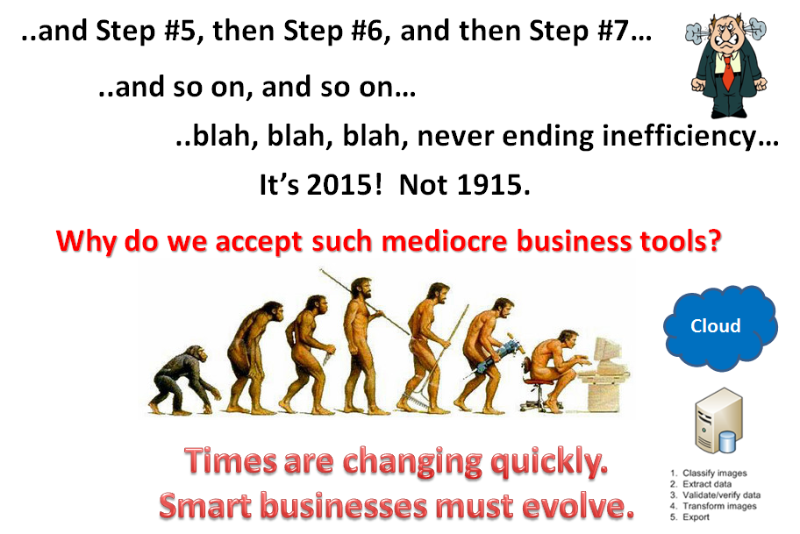
5
5.  Commentary of Frankie-the-frustrated worker:


 “FORGET IT!!!!!!!!!!!! 
 THIS WILL NEVER END!!!!!!!!!!!!!!!!! 
 WHY IS IT LIKE THIS????? 
 ISN’T THERE AN EASIER WAY????????????????” 


6


Education and modern technology reduce Frankie’s frustration

Are we still living in the stone age when it comes to data entry into computer systems?  Isn’t there a more efficient method to automatically populate data in your software application instead of costly manual data entry?  It’s 2012 after all, not 1912.  Why do we accept such primitive methods of data entry?


Answer:  Because we need to educate the market on the capabilities of capture technologies.  We also need to strive to make integration and usage as easy as possible.  If you build it, they will come.


7
Eliminating Frankie’s frustration with Ubiquitous Information Capture
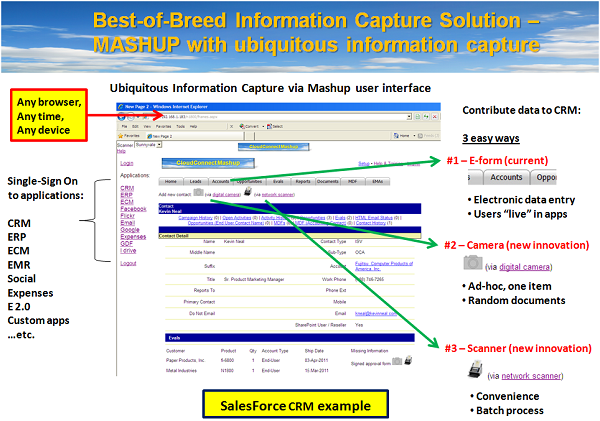
Realizing the dream of Ubiquitous Information Capture directly into applications is much easier than you might think but we must educate the market on current capabilities.  The idea is simple, yet highly effective.  Embed the ability to take photos with a smart phone and/or capture paper documents from a scanning device directly into your software application.  Note that all I’ve done in the screen prints below is add a small icon of a camera and scanner directly into my CloudConnectMashup software application.


8


Now, I can offer my users a truly great user experience because contributing information is nearly effortless and removes pain associated with manual data entry.  This translates directly into reduced operational costs, improved efficiencies and an overall better work environment.


9
Think about all the lost opportunities to drastically reduce labor costs, most likely in the billions if not trillions of dollars, associated with manual data entry in just the use cases below:


1.  Transportation applications with Bills of Lading, Proof of Deliveries, Trip Sheet or Scale Tickets


2.  Field Service applications with Proof of Work delivered, Vehicle Identification Number, Work Orders or Assessment documentation


3.  Contracts Management applications with Amendments, Terms and Conditions or License Agreements


4.  Invoice Management applications with Invoices, corresponding Packing Lists or Proof of Performance


5.  Sales/Contact Relationship Management applications with Business Cards, Agreements or Correspondences


Do you know a Frankie in your organization?  Do you have a story, good or bad, to tell?  I’d love to hear your feedback.


Thanks,
Kevin

Crossing the ECM/Capture Chasm – ‘This is the Renaissance’

Marc Benioff, Salesforce.com CEO, has been famously quoted on his opinion of cloud computing in terms of saturation-point, as well as technology innovation, for a viable business model.

“This is the heyday of the Cloud. This is the Renaissance. We are in the Great Time. ”

…and he continues…

 “So we’re still at the very, very beginning.

We are in the first innings of Cloud Computing.

This is still the Renaissance. ”

While this is just one man’s opinion I personally happen to think he is absolutely correct.  We truly are in the first innings and, in particularly, as it relates to Capture and ECM moving to the cloud.  Future innings have yet to be played.  In this baseball analogy the convergence of old-school “traditional – behind the firewall” technology and new “innovative – cloud collaboration/mobile” technology are on a crash course of epic proportions.

Then on 9/6/2012 as Jeff Bezos, Amazon.com CEO, proudly introduced his companies’ new Kindle Fire tablet device he was quoted as saying the following:

“We want to make money when people use our devices, not when they buy our devices.”


Salesforce.com reinventing themselves

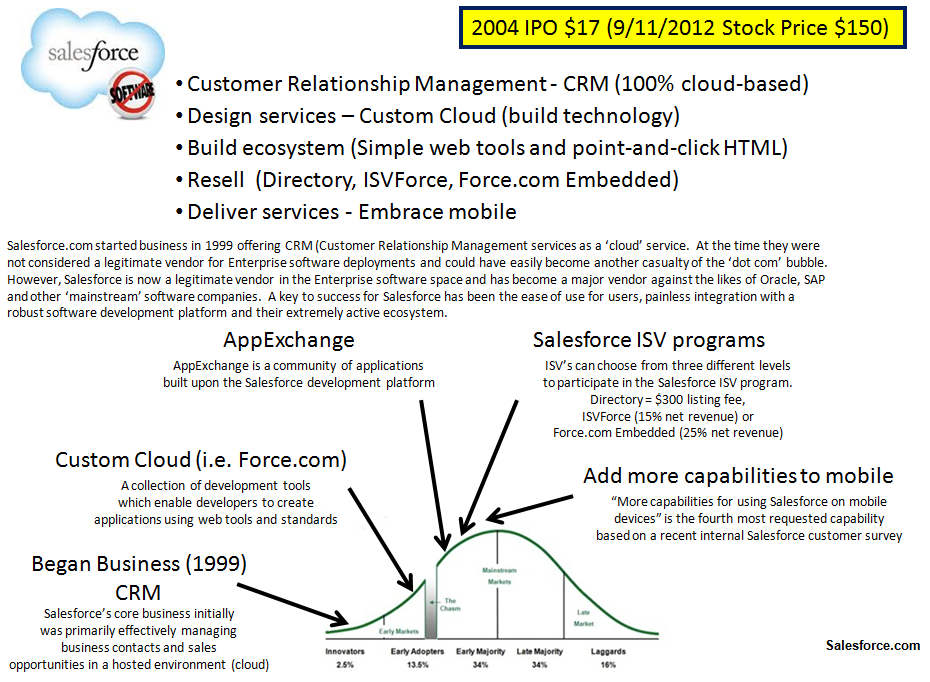
Let’s take a high-level look how Salesforce.com’s business has changed over the years since the company started business in 1999.  They started with their (1) core Customer Relationship Management (CRM) service and then they (2) offered a development platform.  Next, they (3) built an ecosystem of development partners, and then they created sales and marketing programs to (4) resell third-party as well as additional Salesforce.com branded-services.  All along, they have been strong in their advocacy of (5) using mobile devices so they have provided pre-built applications and also development tools for integrators to create mobile applications for Salesforce.com.


salesforce


Amazon.com reinventing themselves

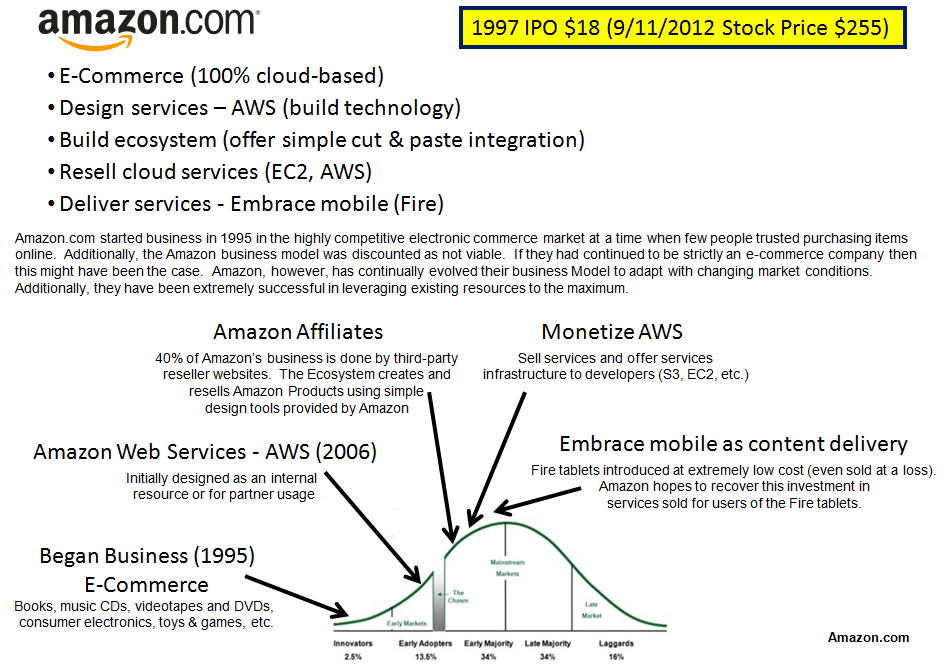
Just like Salesfore.com reinventing themselves; Amazon.com has also done a great job on continually enhancing their business and the formula to success, at a high-level, is amazingly similar.  First, Amazon.com had their (1) core business of electronic commerce selling books and music items.  Next, they (2) built a platform and exposed their product information via Web Services.  Once they offered these Web Services, third-party web sites could integrate and (3) sell products directly from the Amazon.com online catalog with Amazon Affiliates.  Amazon realized their Web Services were world-class and their data center infrastructure could be additional sources of revenue so they started offering Amazon Web Services (AWS) for software developers to (4) create new applications other than just e-commerce.  And, of course, with the recent aggressive announcements with Kindle Fire, Amazon has made a huge investment in the future of (5) delivering content, over the long-term, to mobile devices as a financial business model, not when customers purchase the hardware itself.


amazon


Cloud Capture Convergence

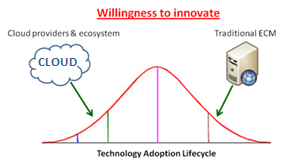
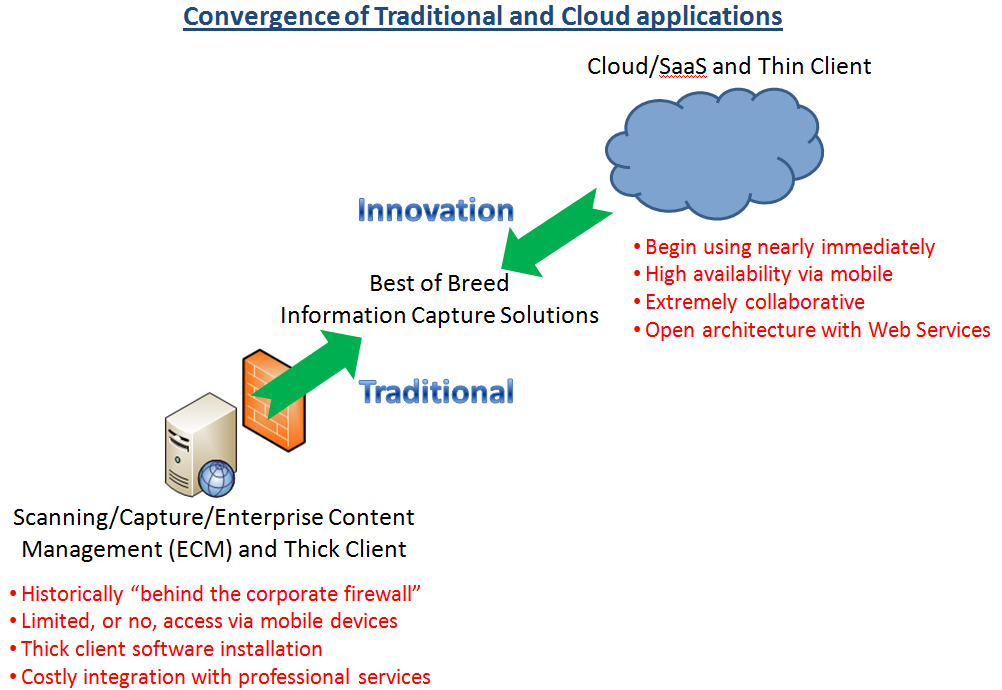
This is not to say that this convergence of Traditional technology and Cloud technology is necessarily a bad thing and, in fact, can be quite good.  For example, ECM systems (or Systems of Record2) have a long history of positive results if implemented and governed properly.  There really is no question about this, however the truth of the matter is that with this legacy comes baggage which slows down technology innovation.  Baggage just means that there is an existing customer base that you must support and there is a feature improvement list gathered from customer feedback that is probably quite extensive.  Also, from a software architecture standpoint, the software was not engineered with modern capabilities such as mulitenancy, web services connectivity or thin client design.


willingness-to-innovate
However, on the complete other end of the technology spectrum you have a whole host of cloud-based, Software as a Service (SaaS) applications (or Systems of Engagement) which are highly collaborative with these modern capabilities, yet most of them lack the most basic capability in terms of enterprise-type features that have proven ROI over the years.  One of the most basic productivity-enhancing and cost-reducing capabilities missing, of course, is automatic Data Capture.  The cost of your investment is really easy to calculate just with the number of labor hours that can be recouped simply by eliminating manual data entry.  I admire these companies of being so forward-thinking that they overlook the obvious.


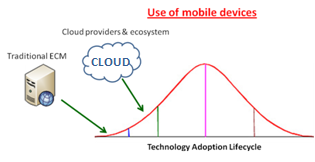
use-of-mobile-devices
 

The formula to success is rather obvious

So what’s the point of me pointing out these bold comments by these CEO’s from some of the more successful cloud companies?  The point is that both Amazon.com and Salesforce.com have quite similar business models now, yet they were born very different companies as their core business.  These companies are quickly transforming into “services” companies.  Both of these companies have fully-embraced cloud as a business model, not just a casual interest, or a fad that will fade away.  Both companies have built amazing technology and integration platforms for developers to quickly and easily create powerful applications like never before.  Each company has created two of the most thriving and robust ecosystems in computing history with partners gladly and enthusiastically promoting solutions built on these respective platforms.  Then one of the newest similarities of these two successful cloud companies is their absolute focus on using mobile devices as a delivery method for their content and services.


The application of the future

So now for my own bold prediction.  As these cloud applications evolve they, too, will start to incorporate core functionality such as automatic Data Capture themselves directly into their applications or mash-up software applications will be created that deliver the realization of best-of-breed solutions.  Let’s use two famous companies and describe the future of a best-of-breed business productivity software application, with specific details.  First, in the “traditional/behind-the firewall” ECM business let’s take Microsoft SharePoint Server.  Unquestionably one of the most popular ECM systems in the industry and very ‘disruptive’ since Microsoft starting sincerely promoting SharePoint as more of a true ECM solution instead of just a collaboration tool.  Secondly, in the “cloud/collaboration-mobile” business let’s take a look at Box.  Box is also a leader in their respective market space of cloud storage with high-security and easily accessable content via mobile devices.  (Admittedly, Box is a much smaller, newer start-up company but a leader none-the-less.)  ‘Where am I going with this vision?’ you might be asking yourself since you might be aware of Box’s infamous bashing of SharePoint as seen below in this billboard advertisement.  Well since these early days the rhetoric has been tempered quite a lot, in my opinion, and might I even dare to say that using each products respective strengths can help achieve the ultimate in business efficiency?

box-net

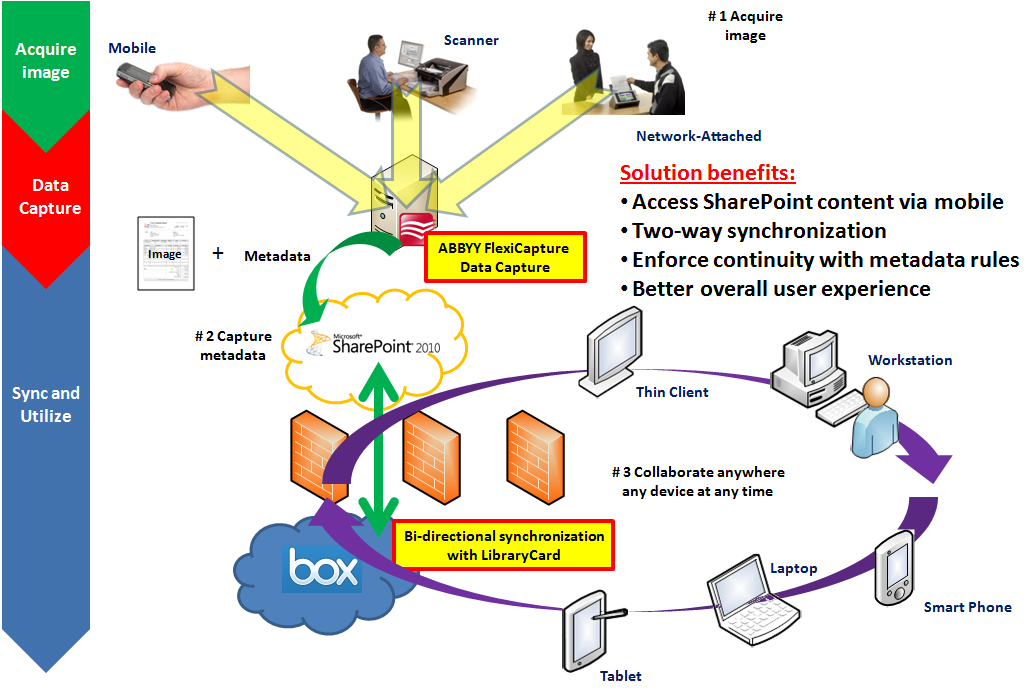
From a pure data capture and ECM standpoint, SharePoint has features that Box simply does not offer.  This includes a robust metadata framework, this also includes enterprise search and managed metadata just to name a few features that inhibit Box from serious contention if an organization requires these traditional ECM capabilities.  However, SharePoint has its own deficiencies and right now one of these areas is poor support for mobile devices.  Box absolutely excels in the area of mobile application development because their service was built with a “mobile first” mentality.  So what if we could blend the positive qualities into one to provide users with the functionality they desire on mobile, yet still adhere to traditional ECM policy and governance with metadata support?

The answer is “you can”.  Through the beauty of modern integration techniques users can now view, manage and edit documents stored in Microsoft SharePoint through the Box user interface on mobile devices.  Just imagine the enhanced productivity that can be achieved through a highly usable experience for the users themselves but also the piece-of-mind that your organization is not sacrificing critical features necessary to run an effective business.


convergence


This is the vision of the application of the future.  Remember, “we are in the first innings – This is the Renaissance.  We are in the Great Time.”


More information:

1Geoffrey Moore:  “Crossing the Chasm: Marketing and Selling High-Tech Products to Mainstream Customers” (amazon.com paperback)

2John Mancini:  “A future history of content management” (slideshare.net presentation)