4/4/2026 Kevin’s Barnhouse Life Update — Spring 2026: Robots, Fur, and Everything In Between


Wow. 2026 has already been a whirlwind — the kind of year where you blink and wonder how you fit all this into just a few months. But in the best way, it’s been full of breakthroughs, laughter, and those little everyday moments that make you stop and smile.

On the tech side, I’ve been diving deep into twAIn Robotics — a project that started with a simple question: what if machines could actually move, sense, and think for themselves? It’s nerdy, it’s exciting, and it’s one of those experiments where you realize the future isn’t coming — it’s already here. I’ve been playing with AI, biometric identity verification, and autonomous robotics control, figuring out how to make smart software and real-world hardware work together. Even if you’re not a robotics geek, it’s fun to imagine a world where robots might eventually help with everyday things — like maybe fetching snacks during a long workday (a person can dream, right?).

What drives me most is building — not just projects or products, but an ecosystem where everyone can gain something meaningful. I’m passionate about connecting ideas, technology, and people in ways that make life easier, more fair, and more engaging. Whether it’s through robotics, writing, or experimenting with new tools, I want the things I create to ripple outward, helping not just me, but anyone who interacts with them. For me, creation isn’t just personal fulfillment — it’s about leaving a space where everyone can benefit and grow.

Earlier this year, I went to the Executive Connection Summit in Scottsdale, which was full of inspiration. From stories of veteran resilience to innovators building the next big thing, it was a reminder that curiosity never goes out of style and the world is full of opportunities if you’re willing to tinker, explore, and sometimes fail spectacularly.

Back at the Neal Family Farmhouse, life is a mix of chaos and charm thanks to Bleu, Ella, Finn, Gracie, J.C., and Tigg. Finn’s mischief, hallway sprints, and random bursts of energy keep us laughing (and occasionally ducking). Bleu’s calm, judgmental stare, Ella’s quiet side-eye, Gracie’s nosy curiosity, J.C.’s old-soul wisdom, and Tigg’s unpredictable antics make sure there’s never a dull moment. They’ve become my co-pilots, my sounding boards, and sometimes my little saboteurs — in the best way possible.

This year also marks another chapter in my 15-year habit of blogging life as it happens. From robotics experiments to the small, silly moments at home, I’ve shared the wins, the fails, and everything in between. The goal has never been perfection — it’s about curiosity, learning, and sharing the chaos that comes with living, thinking, and sometimes tinkering just a little too much.

As we roll into the rest of 2026, I’m looking forward to more robot experiments, more quiet farmhouse moments, more antics from the six of them, and more of those little surprises that make this ride worth every blink, laugh, and head-scratch along the way.


What does the TWAIN Working Group do?

At the recent AIIM International AI+IM Global Summit, we asked the audience if they knew what the TWAIN Working Group does and a majority answered that they did not know, or wanted more information. So we’ve created this short explainer video as a high level overview for our 3 projects of TWAIN Classic, TWAIN Direct and PDF/Raster.

1. TWAIN Classic is a mature specification used for USB document scanners.
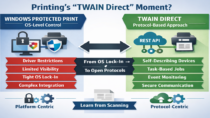
2. TWAIN Direct is a newer, RESTful API architecture, specification used for Ethernet or WiFi scanners and MFP’s.
3. PDF/Raster, or PDF/R, is a simplified version of PDF optimized for document scanning IoT devices.

Stargate, DeepSeek and Energy Efficiencies of AI with the TWAIN Working Group

Last week’s announcement of Stargate—a $500 billion collaboration between SoftBank, Oracle, and OpenAI—got me thinking deeply about something even more critical than the technology itself: the energy required for such massive artificial intelligence projects. This was top of mind even before this week’s announcement of DeepSeek, China’s alternative AI system, and I touched on it during the 1/24/2025 Post & Walters Ask Us Anything live podcast. When asked about my most urgent priority, I said “Energy,” and for good reason.

Oracle’s construction of massive new data centers highlights just how much space and energy these infrastructures demand. We’re now at a point where nuclear energy is being seriously considered—and in some cases, implemented—as a power source for data centers. While this level of energy use isn’t inherently bad, it raises an important question: How can we consume energy more economically and use it more efficiently?

To put this into perspective, let’s draw a parallel with the evolution of personal computers and operating systems. In the early days, when CPUs, RAM, and storage were expensive, operating system developers worked hard to optimize resource usage. However, as these components became cheaper and more abundant, efficiency often fell by the wayside, giving rise to “bloatware.” For example, the size of operating systems ballooned from Windows 3.1, which required just 6.7 MB, to modern versions occupying several gigabytes. Similar inefficiencies can be seen in software like Optical Character Recognition (OCR) tools.

Now consider Stargate, which relies on an immense data center infrastructure and consumes vast amounts of energy. Just days later, China announced DeepSeek, a competing AI system built at 1/1000th the cost ($5.6 million vs. $500 billion) and designed to use significantly less energy. According to this article, DeepSeek achieves remarkable energy efficiency, partly because sanctions on chip exports forced its creators to innovate rather than rely on resource-intensive “bloatware.” Early reviews suggest DeepSeek is an impressive competitor to ChatGPT, showing what can be achieved through intelligent, resource-conscious design.

This focus on efficiency resonates with my work on energy-conscious innovations at the TWAIN Working Group (TWG). It’s thrilling to collaborate on designing intelligent AI systems while having a meaningful, positive impact on our planet—a trifecta that aligns with my professional and personal values.

One of TWG’s key initiatives is our integration of TWAIN Direct and PDF/R technologies into RISC-V CPU chips. This enables document scanners to operate independently of external computers, reducing the need for additional CPUs, RAM, and energy. With these technologies embedded directly into IoT devices, we can develop smarter systems that consume less power. For instance, machine learning models can train in the cloud to recognize document patterns and classifications, then push those models down to the RISC-V chip for on-device classification. This approach minimizes data transmission to the cloud and enhances energy efficiency, while continuously improving through feedback loops.

Another exciting project is the addition of JPEG-XL to the PDF/R specification. Our recent white paper, The Benefits of Adding JPEG-XL to the ISO PDF Standard and PDF/Raster,” highlights how this advanced compression format reduces file sizes, conserves storage, streamlines transmission, and encourages digital collaboration over print.

These initiatives are part of a broader strategic objective: providing secure content collaboration solutions. While this challenge might seem solved, it’s an ongoing process of innovation to combat cyber threats and ensure content authenticity, provenance, and transparency. TWG has developed reference platforms for secure documents, integrating blockchain hashing for document verification, C2PA standards for content authenticity, and advanced access controls with biometric and multifactor authentication. These solutions span various types of digital content, from photos and videos to PDF files produced by TWAIN Direct scanners.

Putting all of this together offers us all the promise that A.I. can provide, encourages safe, secure and authentic digital collaboration and, which is of great importance, converses energy so that we can all live our best lives and provide a healthy planet Earth for future generations.

With so many groundbreaking projects underway, the TWAIN Working Group and P3iD Technologies welcome anyone interested to join us. Whether you want to dip your toes in or dive in head-first, there’s a place for you in this journey of innovation.

Capture & IDP Conference 2023 – TWAIN Working Group

It was a great honor for me to represent the @TWAIN Working Group at the Infosource Capture & IDP Conference last week in Chicago. I provided an update to the attendees on “Monetizing TWAIN Direct” with some examples of Use Cases for Generative AI, Conversational AI and Document Processing AI with TWAIN Direct. Then I shared our success with TWAIN Direct Developers Day in Safety Harbor, Florida as well as the TWAIN Direct ISV Showcase Series webinars. Finally, I thanked our valued member companies and encouraged membership to be part of the Digital Transformation AI future with TWAIN!

At the Infosource Capture & IDP Conference last week, I shared some real Artificial Intelligence use cases for TWAIN Direct. I was having some fun with the TWAIN acronym, to get the audiences attention and to fit in with the theme of AI, but I was also very serious about incorporating various techniques of AI including Generative AI, Conversational AI, and Document Processing/Analytics AI to illustrate the strategic importance of TWAIN Direct to the AI ecosystem

One of the TWAIN Working Group highlights I shared at the Infosource Capture & IDP Conference last week, was TWAIN Direct Developers Day (TD-DD). TD-DD was a terrific and energy-filled day of seeing TWAIN Direct in action. In one day software developers were able to get a functioning TWAIN Direct document scanning application working. Some feedback included: “Integration of TWAIN Direct was simple and easy”, “There was a good vibe at Developers Day” and “The partner ecosystem and ISV solutions for TWAIN Direct are really impressive”. We will be hosting another Developers Day in Spring 2024 so please send me a message for more details.

Fitting directly in the theme of my presentation of “Monetizing TWAIN Direct” at the Infosource Capture & IDP Conference last week, was sharing the TWAIN Direct ISV Showcase Series. This ongoing webinar series, hosted by the TWAIN Working Group, included various topics such as cybersecurity, cashflow management, content management, file conversion, capture, and more, featuring our growing ecosystem of software partners and integrations. Please send me a message if you’d like to be included in future TWAIN Direct ISV Showcase Series webinars.

As a non-profit organization, the TWAIN Working Group is supported by our valued member companies. At the @Infosource Capture & IDP Conference last week, many were in attendance including Atalasoft/Kofax, Epson, Kodak Alaris, PFU, P3iD Technologies and Visioneer. Since TWAIN is an open-source specification, our organization is selling nothing and charges no commercial licensing fees. Our only motivation is to provide a solid industry-leading and accepted standard for scanning device-to-software application communication. I’m pleased to share that at the Conference, the state of document scanning with TWAIN Direct has a very bright future and each opportunity means tangible business for one, or many, of our valued member companies.