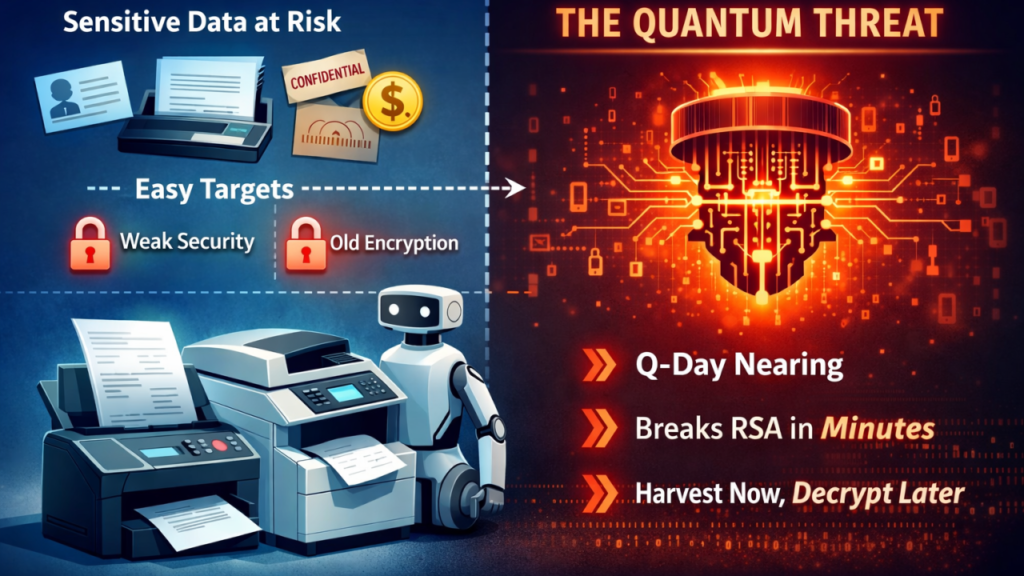
Most organizations still treat scanners, MFPs, and even service robots like harmless office equipment.
But here’s the reality: they process some of your most sensitive data—and they’re among the easiest systems to compromise.
Now layer in what’s coming next.
Q-Day Is Closer Than Most People Think
“Q-Day” refers to the moment when quantum computers can break today’s standard encryption.
While no one knows the exact date, the consensus across governments and industry is clear:
- Google is now warning that quantum computers could break current encryption by 2029
- That’s a shift from earlier expectations of the mid-2030s
- Experts already estimate a meaningful probability before 2035
That timeline matters because your devices will still be in use when it happens.
Today’s Encryption Has a Shelf Life
Most scanners, MFPs, and connected robots rely on encryption like RSA or ECC.
Here’s the problem:
- Traditional computers would take thousands to millions of years to break strong RSA encryption
- A quantum computer running Shor’s algorithm could potentially break it in hours—or even minutes once scaled
That’s not an incremental improvement. That’s a complete collapse of the current security model.
“Harvest Now, Decrypt Later” Is Already a Real Threat
Attackers don’t need to wait for Q-Day.
They can:
- Intercept encrypted data today
- Store it indefinitely
- Decrypt it later when quantum capability is available
So every document scanned today—contracts, IDs, financial records—could be exposed in the future if it’s protected with today’s encryption.
Why Scanners, MFPs, and Robots Are Especially Vulnerable
These devices are uniquely exposed:
- They handle high-value, long-lived data
- They are often poorly monitored and rarely updated
- They remain deployed for years or even decades
- They are increasingly connected to cloud and API-driven workflows
In many environments, compromising a printer or scanner is easier than attacking a server.
And once compromised, it becomes a silent data collection point.
What Happens to RSA When Q-Day Hits?
When large-scale quantum computers arrive:
- RSA and ECC-based encryption will become effectively obsolete
- Digital signatures can be forged
- Secure communications can be decoded retroactively
- Device identity and trust models will break down
In simple terms: systems that were considered secure will no longer be trustworthy.
Why This Is a Bigger Problem for Physical-Digital Systems
Scanners, MFPs, and robots don’t just store data—they create records of truth:
- A scanned contract
- A verified identity document
- A robot’s maintenance report
If those records can be altered, forged, or decrypted later, the integrity of entire workflows is at risk.
The Clock Is Already Ticking
Here’s the key point most organizations miss:
You don’t secure data when Q-Day arrives. You secure it before it’s created.
Devices being installed today will still be operating in the quantum era.
If they rely on outdated encryption, they become long-term liabilities.
The Bottom Line
- Today’s encryption works—for now
- Quantum computing will break it—fast
- Attackers are already preparing—today
And the weakest entry points into your organization may not be your servers…
They may be your scanners, your MFPs, and your robots.
Post-quantum cryptography isn’t theoretical. It’s the difference between data that stays protected—and data that eventually gets exposed.