Why Document Scanners, MFPs, and Robots Are Sitting Ducks in a Post-Quantum World

Most organizations still treat scanners, MFPs, and even service robots like harmless office equipment.

But here’s the reality: they process some of your most sensitive data—and they’re among the easiest systems to compromise.

Now layer in what’s coming next.

Q-Day Is Closer Than Most People Think

“Q-Day” refers to the moment when quantum computers can break today’s standard encryption.

While no one knows the exact date, the consensus across governments and industry is clear:

  • Google is now warning that quantum computers could break current encryption by 2029
  • That’s a shift from earlier expectations of the mid-2030s
  • Experts already estimate a meaningful probability before 2035

That timeline matters because your devices will still be in use when it happens.

Today’s Encryption Has a Shelf Life

Most scanners, MFPs, and connected robots rely on encryption like RSA or ECC.

Here’s the problem:

  • Traditional computers would take thousands to millions of years to break strong RSA encryption
  • A quantum computer running Shor’s algorithm could potentially break it in hours—or even minutes once scaled

That’s not an incremental improvement. That’s a complete collapse of the current security model.

“Harvest Now, Decrypt Later” Is Already a Real Threat

Attackers don’t need to wait for Q-Day.

They can:

  1. Intercept encrypted data today
  2. Store it indefinitely
  3. Decrypt it later when quantum capability is available

So every document scanned today—contracts, IDs, financial records—could be exposed in the future if it’s protected with today’s encryption.

Why Scanners, MFPs, and Robots Are Especially Vulnerable

These devices are uniquely exposed:

  • They handle high-value, long-lived data
  • They are often poorly monitored and rarely updated
  • They remain deployed for years or even decades
  • They are increasingly connected to cloud and API-driven workflows

In many environments, compromising a printer or scanner is easier than attacking a server.

And once compromised, it becomes a silent data collection point.

What Happens to RSA When Q-Day Hits?

When large-scale quantum computers arrive:

  • RSA and ECC-based encryption will become effectively obsolete
  • Digital signatures can be forged
  • Secure communications can be decoded retroactively
  • Device identity and trust models will break down

In simple terms: systems that were considered secure will no longer be trustworthy.

Why This Is a Bigger Problem for Physical-Digital Systems

Scanners, MFPs, and robots don’t just store data—they create records of truth:

  • A scanned contract
  • A verified identity document
  • A robot’s maintenance report

If those records can be altered, forged, or decrypted later, the integrity of entire workflows is at risk.

The Clock Is Already Ticking

Here’s the key point most organizations miss:

You don’t secure data when Q-Day arrives. You secure it before it’s created.

Devices being installed today will still be operating in the quantum era.

If they rely on outdated encryption, they become long-term liabilities.

The Bottom Line

  • Today’s encryption works—for now
  • Quantum computing will break it—fast
  • Attackers are already preparing—today

And the weakest entry points into your organization may not be your servers…

They may be your scanners, your MFPs, and your robots.

Post-quantum cryptography isn’t theoretical. It’s the difference between data that stays protected—and data that eventually gets exposed.
Blockchain for Healthcare


Let me start this story and cut right to the chase. At my recent physical therapy visit there was an error in my medical record chart.

This was no big deal for me other than just setting the record straight with the therapist but, as you might imagine, it could have negative implications for the person whom this important information is most likely missing from their medical record chart because it was in my chart instead of theirs.

How or why this happened is something I can not know for sure but I can only assume it was an honest mistake. Everyone gets busy or distracted at times during their work day and somehow these records ended-up in my chart and not this other patient.

However, the big question I consider in situations like this is ‘what can be done to avoid this sort of medical record records mistake in the future?’. This was my immediate thought after I noticed the look on my physical therapist face when he realized the mistake. Let me briefly explain.

I was at my first physical therapy appointment since ‘ankle’ surgery a few months ago where I was the fortunate recipient of several titanium plates and complimentary screws. As the nice therapist was asking the normal background questions that are to be expected, and I was answering accordingly, he then asked a stunner.

He asked, “well, Kevin, you have a lot of metal in that ankle so how is the other metal in your knee feeling?”.

Naturally shocked, I said, “uhhh, sorry sir, no metal in my knee and no surgery on my knee ever”. I then turned to my wife and said, “Honey, you see this is prime example of where a Blockchain for Healthcare could have prevented such a mistake in my medical record”. We both had a chuckle then we moved on to the rest of my ankle rehab session.

However, and in all seriousness, this simple little incident is a real-world example that likely happens on a regular basis all across the country and all around the world. It simply should not happen with today’s modern technological innovations.

Specifically, I’m referring to a few simple modern technological concepts that are real, possible and should be implemented for the better accuracy of not only medical records, but in every business and all industries. These concepts are Digital Ledger Technology (DLT), Smart Contracts and Consensus or to summarize, Blockchain.

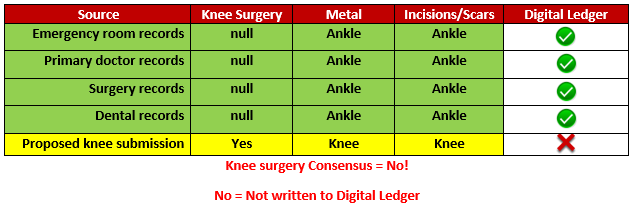
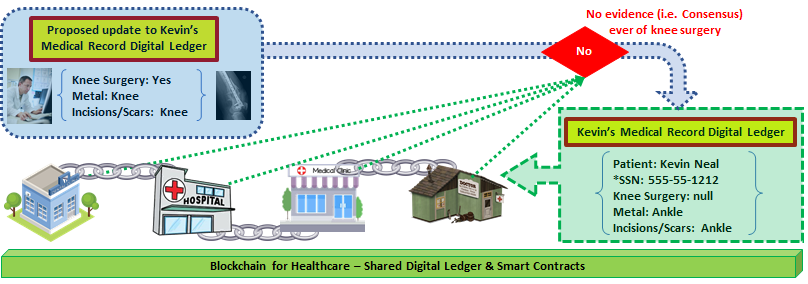
Why wouldn’t have this erroneous record made it into my medical chart when it wasn’t truly linked to me? In a blockchain it’s really easy to understand how this could have been prevented through a ‘consensus’ network. Consensus in blockchain, and there are several ways to arrive at consensus, is just like you might imagine in that there is basically a consensus decision among peers of ‘yes’ or ‘no’ to a particular question or request. So, in my specific case, when the incorrect knee surgery chart information was being submitted into my medical record chart the system itself should have formed a consensus that this was not a valid transaction and not allowed it. Ideally it would have kicked off an exception workflow process for handling such situations.

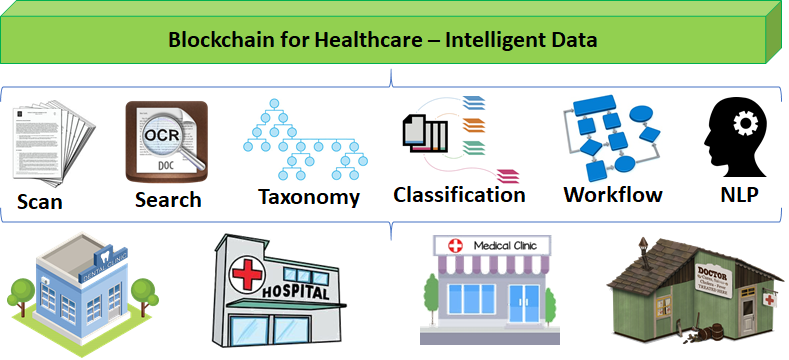
Consensus is formed by a network of distributed computers (i.e. ‘cloud computing’) using Smart Contracts. Smart Contracts, as it relates to blockchain, are basically decision makers. Software developers and/or organizations themselves, which have deep knowledge of their particular vertical markets, can rather easily create Smart Contracts which can allow computers to make informed decisions based on all the intelligent data available. And, believe me, there is a lot of electronic data in Healthcare that can be made intelligent through various techniques and that affords great opportunity for really smart decisions to be made that can be nearly fully automated.

And then, finally, after Consensus is arrived upon by using Smart Contracts then a Digital Ledger is either updated or not. A Digital Ledger is a shared, current real-time state of ‘truth’. This is like a gigantic distributed database where each computer in a blockchain has its own copy of the database and it is always updated to reflect the most accurate version of the ‘truth’, whatever that may be. The Digital Ledger is always synced among peer members and updated (i.e. adding ‘blocks to the chain’) with the latest version.

In my particular case, my medical record Digital Ledger would include all previous interactions and transactions recorded about my medical history including emergency room records, primary doctor records, surgery records and even my dental records. This is an example of four data sources, however in a real blockchain this could have been hundreds, thousands or millions of computers all working together to make informed, smart consensus decisions. Just imagine how difficult it would be to try and trick a blockchain of any significant size? You would have to reverse-engineer the ledgers of all these verified transactions previously recorded.

As the blockchain grows and gains other supporting nodes, data and more horsepower, then this only increases the level of tamper-resistance, more granular decisions can be formed based on more data and no single point of failure for data.

For these reasons, this is why Blockchain for Healthcare has a bright future in making positive life decisions with intelligent data and can also help prevent medical record mistakes.