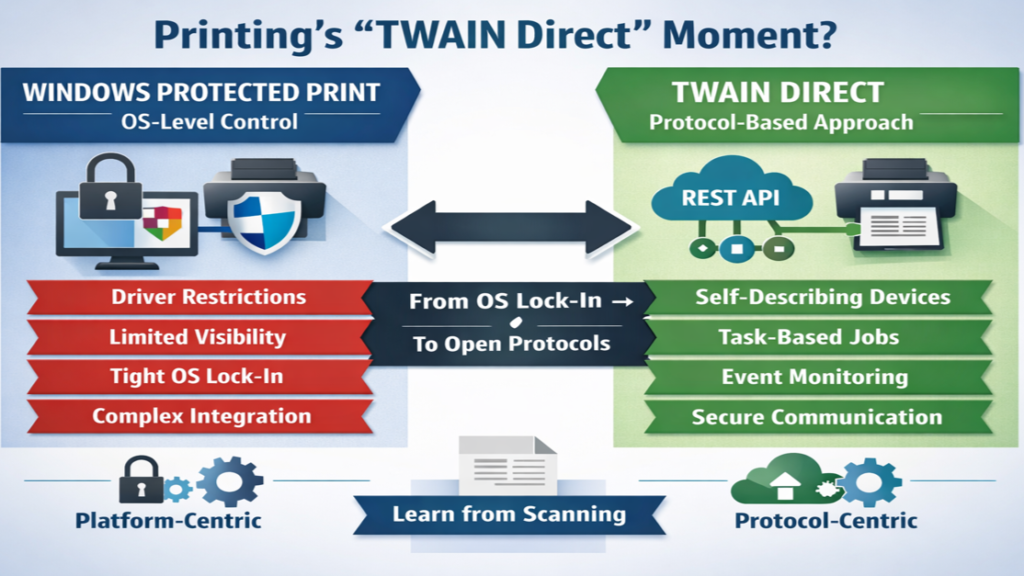
There’s a growing tension in enterprise print environments: the requirement for security and control versus the need for flexibility and interoperability. Microsoft’s Windows Protected Print (WPP) initiative is a clear attempt to modernize and secure printing—but like many security-first architectures, it introduces friction that organizations are now struggling to navigate.
Interestingly, we’ve already solved a very similar problem in another domain: document scanning.
That solution is TWAIN Direct.
The Core Problem: Control vs. Usability
Windows Protected Print aims to eliminate traditional print drivers, enforce stricter pipelines, and reduce attack surfaces. On paper (no pun intended), that’s exactly what IT departments want.
But in practice, it creates real challenges:
- Vendor lock-in or limited extensibility
- Reduced visibility into device behavior
- Difficulty integrating with existing workflows
- Constraints on innovation at the edge
If this sounds familiar, it should—these are the exact same problems the scanning industry faced for decades with legacy TWAIN drivers.
The TWAIN Direct Breakthrough
TWAIN Direct didn’t just “improve” scanning—it re-architected the entire model.
Instead of tightly coupling applications to device drivers, TWAIN Direct introduced:
- A network-based, RESTful communication model
- Self-describing devices (via capabilities)
- Asynchronous task execution
- Event-driven status reporting
- Driverless operation
In short, it decoupled what you want to do from how the device does it.
That shift unlocked interoperability, observability, and innovation—all while improving security.
The Analogy: Printing Needs Its “TWAIN Direct Moment”
Windows Protected Print is trying to solve security by tightening control at the OS level. But TWAIN Direct shows us a different path:
Move intelligence to the protocol layer, not the platform layer.
Imagine if printing followed the same principles:
1. Self-Describing Printers (Capabilities Model)
Instead of rigid driver definitions, printers could expose their capabilities dynamically:
- Supported formats
- Finishing options
- Security requirements
Applications adapt in real-time—no driver installation required.
2. Task-Based Print Jobs
Rather than sending opaque print streams, clients submit structured “tasks”:
- “Print 10 copies, duplex, staple”
- With embedded policy and validation
This mirrors TWAIN Direct’s task model and enables better auditing and control.
3. Event-Driven Observability
One of the most underrated strengths of TWAIN Direct is its eventing model:
- Job started
- Page scanned
- Error occurred
- Job completed
Apply this to printing, and suddenly WPP gains:
- Real-time monitoring
- Better troubleshooting
- True device-level telemetry
4. Secure, Network-Native Communication
TWAIN Direct assumes secure HTTP-based communication from the start:
- TLS encryption
- Token-based authentication
- No reliance on local drivers
This aligns perfectly with WPP’s security goals—but without sacrificing openness.
Where Windows Protected Print Falls Short
WPP is solving yesterday’s problem (driver vulnerabilities) with yesterday’s architecture (OS-level enforcement).
TWAIN Direct demonstrates that the real solution is:
- Protocol standardization instead of platform restriction
- Device intelligence instead of driver dependency
- Open ecosystems instead of controlled pipelines
The Bigger Opportunity
This isn’t just about printing or scanning—it’s about how we design device communication in the age of cloud, AI, and zero trust.
TWAIN Direct proves that you can have:
- Security
- Simplicity
- Interoperability
- Observability
…without compromise.
If Windows Protected Print evolves to embrace these principles, it could become more than a security feature—it could become the foundation for the next generation of print infrastructure.
Final Thought
The scanning industry already went through this transformation—and came out stronger on the other side.
Printing doesn’t need to reinvent the wheel.
It just needs to recognize that the blueprint already exists.
It’s called TWAIN Direct.