


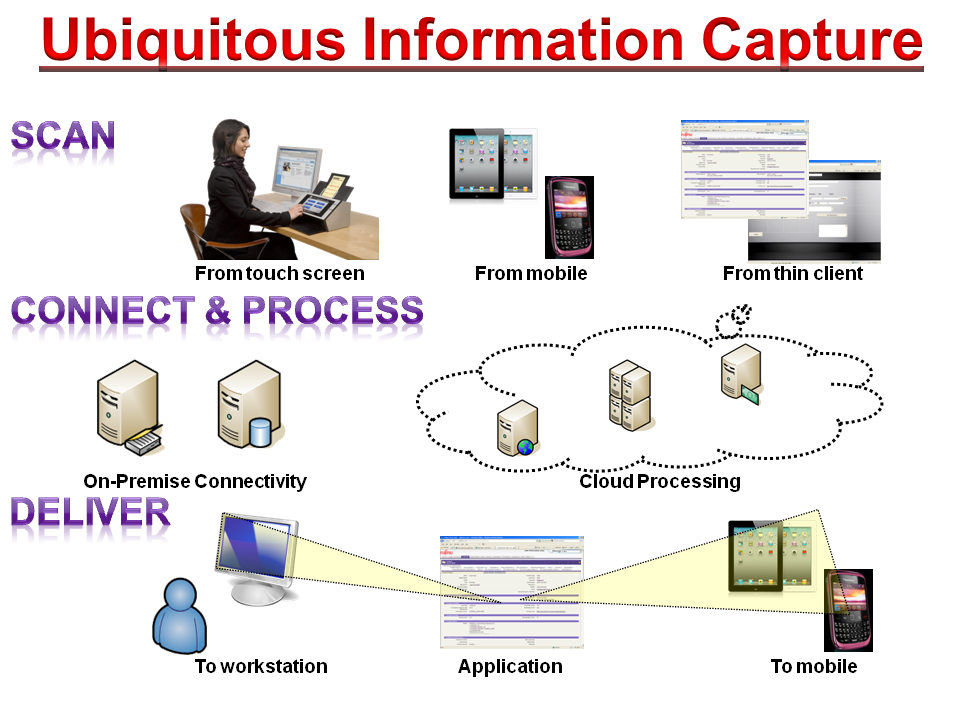
Accessing content from mobile is certainly an undeniable trend as the proliferation of these devices continues within business organizations, as well as for personal use. One of the inherit issues with these devices is that they are primarily used for “consumption” and not “contribution”. Frankly, contributing content from mobile has been challenging, if not impossible. Small display sizes, awkward keyboards and/or lack of integration have all been factors. However, times are changing and technology is now available to help make contributing content via mobile much easier. I would even venture to say that, in certain cases, the novelty of using this cutting-edge technology to contribute content is almost “fun”. The same way that people upload and tag a picture to Facebook can be the same experience someone can automatically capture information from a business card, expense receipt or business document and upload to a repository.
The challenges of information capture via mobile are to be expected when there is so much new technology convergence, and especially, when all of these technologies are potential ‘game-changers’: Mobile, Information Capture, Enterprise 2.0/Social and Cloud.
Forward-thinking technology vendors, savvy systems integrators or end-user organizations that choose to truly embrace and begin to harness the power of these platforms have a tremendous opportunity to design extremely easy to use, yet highly effective ubiquitous information capture via mobile solutions.
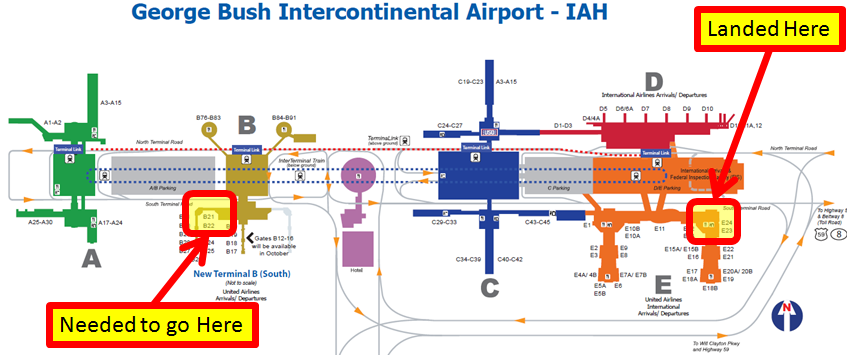
This was one of the funniest experiences I’ve ever had during air travel. This event happened at the Houston airport on March 24, 2011 and I tell the story below the photo.

The cart-driver guy was like a mad man. Literally, not 20 seconds after I had left the jetway and before I could even check the TV monitors if there had a gate change, he drive right in and aggressive (but nicely) asked “where you going sir?”. Shocked that he had picked me out of the crowd without my even asking for a ride, I said, “uhhh well E15 I guess” which was the gate printed on my ticket. He said in an excited voice “alright, get in, take the backpack off, it’s a long haul, let’s go!!”. The total transaction happened in a flash.
So as we were making the trip through the airport terminal with the pedal-to-the-metal he’s proudly and boldly announcing his presence throughout the airport: “Excuse the cart ma’am! Excuse the cart sir!”. All along the ride he’s randomly picking out unsuspecting travelers out of the crowd: “where you headed sir?” “Where you headed ma’am?”. Before not too long the cart is at capacity. Every turn was a great adventure regardless if a passenger was within a country-mile or not: “The CART is making a right turn now!” as he gestures with his hands a right-turn.
My gate was the furthest away so we ended up touring the entire Houston airport and he memorized every persons stop the first time we each told him. He was driving like a bat out of hell! It was hilarious and great to witness him enjoy his work so much so next time you are in the Houston airport and here “EXCUSE THE CART!” you better act quick!
 I just finished watching the movie “The Social Network”. Not sure how much is fact or how much is fiction but nevertheless I found it entertaining.
The movie was a good dose of the entrepreneurial spirit, a slice of the harshness that is the business world and a great life lesson on being honest and true to your friendships. It’s hard to believe that the phenomenon known as “facebook” is basically only 7 years old. According to the movie, facebook was incorporated in 2004. It started as nothing more than a simple web site in an already crowded field of similar “social” sites all of which were vying for more and more users.
If you believe the film you are led to believe that Mark Zuckerberg adamantly resisted the temptation to start selling advertisements on the site once they had achieved modest success. I have not researched, nor paid much attention to how Zuckerberg ran the company at the time, but as a facebook member for quite a while now and seeing how the site has evolved over time it’s not hard to believe that this is true of his philosophy. From a business perspective, and especially for a web site business, I have personally witnessed what once started as a good social site become quickly overran with obnoxious advertisements, non-stop pop-up banners and/or infested with viruses/Trojans or spyware. Anyone remember the likes of Geocities, Limewire or even, dare I say, MySpace? All of which are gone or soon to-be gone.
While I do recall some frustration with facebook outages a few years ago when they were growing and adding so many users very quickly, the truth is that the service has been extremely reliable to my standards which are pretty high when it comes to service availability. Also, facebook does serve advertisements but I think they are subtle enough that it’s not annoying and the ads are not all x-rated like so many other web sites these days. This shows some level of responsibility and decorum on the part of facebook to keep their community clean and fun for everyone. I’m sure porn sponsors would love nothing more than to pay big money to serve stupid ads that have the potential to be seen by more than 500 million users!
Overall I think the movie had a good moral story. You almost can’t blame a young successful kid for making silly mistakes. For example (warning: spoiler-alert if you haven’t seen the movie), Zuckerberg allowed himself to get caught up in the fast-paced, party lifestyle that was introduced to him by the founder of Napster, Sean Parker. This mentorship by Sean Parker was both a blessing as well as a curse. This ‘friendship’ and the business connections that Sean Parker had allowed facebook to get the venture capital investment that allowed them to become legitimate and ultimately become the company they are to this very day. At the end of the movie, which is already a bit dated (released in 2010) they said the net worth of facebook was $25 billion dollars. I’ve heard estimations as high as a $50 billion dollar net worth and I know for a fact that they just raised $1.5 billion in additional investment so it’s clear in the business community that there is serious value here and well worth investing. Just a random Kevin Neal thought here but the real challenge with all these cool web based ideas is how to monetize a cool idea.
Anyhow, the curse of the ‘friendship’ with Sean Parker was that apparently his personal character was shady and unprofessional at times. Sure, he had the business connections to get facebook the financial investments they needed to succeed but his personal conduct could have nearly ruined the business as well.
I got the feeling at the end of the movie that writers portrayed Zuckerberg as missing something emotionally in spite of his success. He missed his ex-girlfriend as well as his original business partner.
Some interesting items I found from the movie:
• I love analogies and this was a good one from Sean Parker’s character. “Will you be known for fishing the 3000 pound marlin or 14 trout?”
• Simple ideas can truly be magical with a little common sense and a lot of hard work
• Be true to your friends and don’t trust posers
It will be interesting for me to finally now do some research on the ‘real’ story and see how much of the movie was reality versus fiction. I give The Social Network a eight out of ten Steeler-star rating.


After a few false starts, and probably an industry getting ahead of itself, document scanner hardware vendors and document capture software vendors finally seem to grasp the opportunity of network scanning. However, and certainly more importantly than the vendors themselves better understanding the significant trend towards network scanning, end-user customers are demanding these types of devices more than ever. The concept of ‘networking scanning’ blends appeal points that cross corporate departmental boundaries for the benefit of the organization.
In essence a network scanner has four main qualities that are fairly common among devices and each quality can be mapped directly to the appeal points highlighted above.
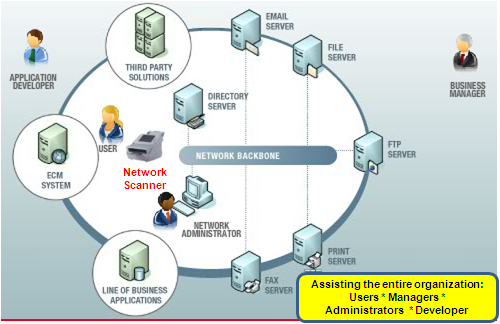
One, the device itself is a complete solution. In other words, a network scanner obviously includes a scanning engine. Also it includes other components and software that does not require the scanner be attached to a computer. A network scanner attaches directly to the network via a network cable and can be managed from a centralized location. As you can imagine this is quite appealing for Network Administrators.
|
|
• Decrease deployment costs with remote administration tools • Reduce ongoing maintenance costs with ability to push updates to devices from a centralized location • Utilize existing network resources and systems to conserve budget • Inexpensive and user replaceable consumables
|
Two, an important distinction between traditional USB-attached document scanners and network scanners is that the users operate the network scanner via a touch screen interface instead of a mouse and keyboard. Using a network scanner requires little or no training which is helping drive quick adoption of the technology because it is not intimidating to use these devices. From a Users perspective scanning documents is no longer a tedious task and makes a network scanner appealing.
|
|
• No need to wait for the copy machine to become free for use • Versatile functionality without compromise of added complexity • Advanced scanning functions performed transparent to user • Ability to preview images before sending to destinations • Simple operation easy to understand
|
Third, versatile Main Menu functionality including general office functions such as scan to e-mail/folders/printers and fax makes sharing of scanned images simple and efficient for users. Additionally, Job Menu’s and Job Buttons can be configured to offer customized interface screens based on user login credentials and one-button scanning for commonly used job tasks. However, one of the most appealing points for Business Managers is the ability to offer ‘integrated’ scanning solutions directly from the touch screen interface. Let me be specific.
|
|
• Restrict access to only authorized users with secure authentication • Highly secure login authentication and transmission protocols • Programmable job function buttons can perform repetitive tasks with the touch of one button • Lock-down job profiles to adhere to organization established • Simple touch screen driven scanning operation eliminates • Eliminate complexity and provide simply operation with large
|
This fourth main appeal point is also the reason why Software Developer’s are trending towards network scanning. While scanning to folders and e-mail is a nice feature of a network scanner, the ability to scan directly into your organizations Enterprise Resource Planning (ERP) application, add metadata/index values to scanned images to add to your Enterprise Content Management (ECM) repository or even provide sophisticated document capture like bar code recognition, document separation to kick-off a workflow process is of tremendous value to increase efficiency. Especially with all the attention of cloud computing and web services these days, network scanners offers savvy software developers a simplified platform to design highly effective and extremely functional applications, yet also benefit from simplified deployment and ease of use that these devices offer to users and network administrators.
|
|
• Direct connectivity to back-end systems • Index values and metadata sent directly into Content Management repositories • Database lookups for validation • Image enable your Line of Business application
|
In summary, network scanning technology has matured to the point of being no longer being only for the trend-setting IT departments to deploy to their users. This technology has progressed to the point where near immediate return on investment can be tangibly achieved and there are many industry success stories to support these claims. When considering your distributed scanning strategy, network scanners should certainly be part of the conversation because the Trend toward Network Scanning is undeniable.
As always I appreciate the time you’ve spent to read this posting about ‘Trends towards Network Scanning’ and how considering this technology helps streamline efficiencies for the benefit of the entire organization and not just a single department or business unit. I welcome comments, feedback and/or constructive criticism. Please feel free to click ‘The SharePoint effect’ graphic below to read about one of the other trends witnessed in 2010 that changed the Document Capture landscape forever.
-Kevin